
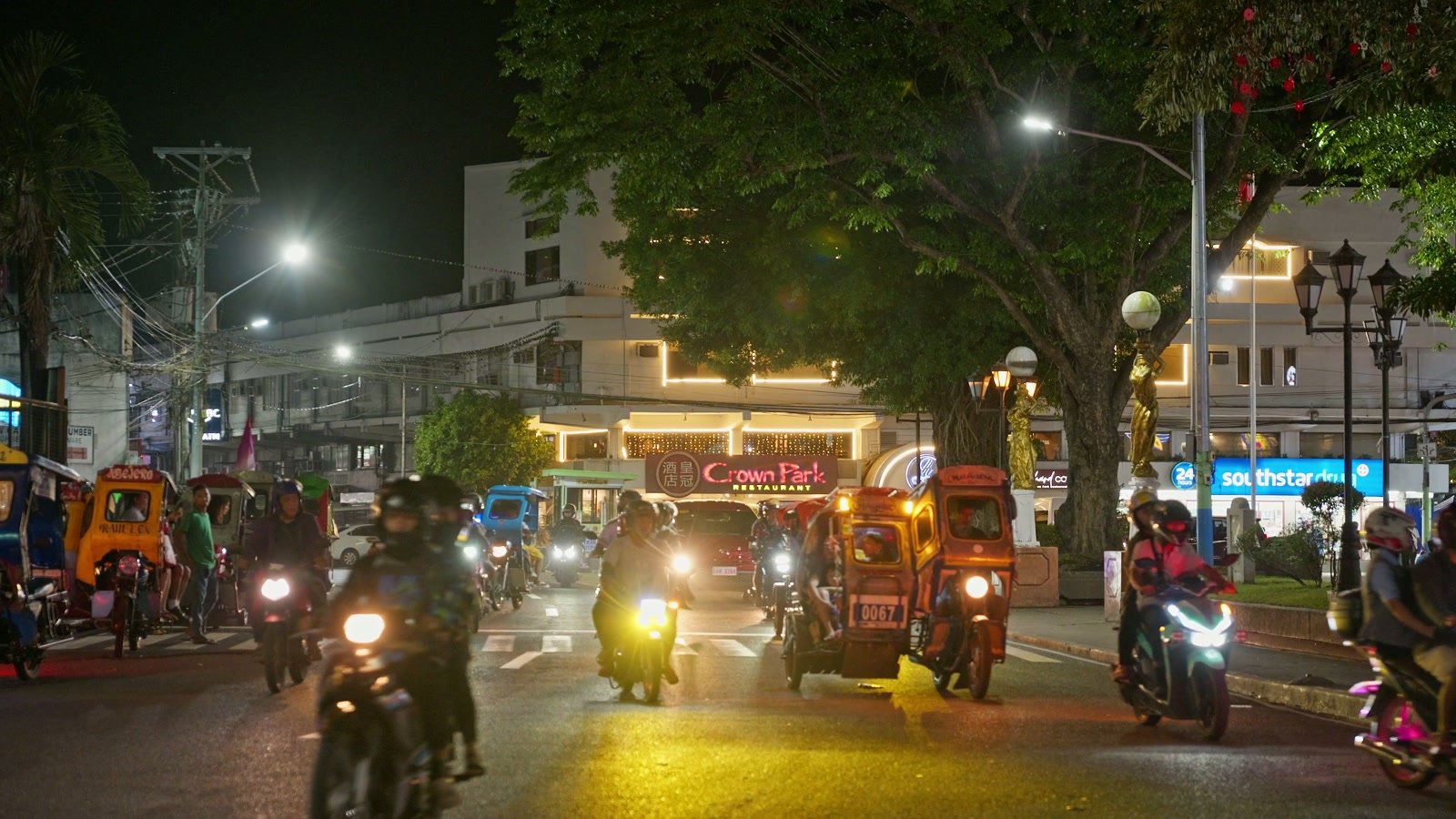
In short: the first practical question from anyone thinking about a long stay is not about beaches. It is about how you get to the market on a Tuesday. In Camarines Sur the answer has three wheels inside Naga, two between the complex and the city, and a fifty-minute flight when Manila calls. Here is what we know with a watch in hand, and what we are not ready to state yet.
The question that comes before the wifi one
Come for a week and you sort transport at the airport and forget about it. Come for three months and you start doing sums. The first thing you find is that people here run a whole life without a car, and nobody treats it as a sacrifice.
Scale helps. Short hops are tricycle territory, middle distances belong to the motorbike, and the bus and the plane take care of leaving the province. Cars exist, of course. You just do not need one to have a normal week.
Let us go from near to far.
Inside Naga, the tricycle runs the show
City Hall paperwork calls it a trimobile: a motorbike with a passenger sidecar. It is the everyday transport of the city, and it is regulated in far more detail than you would expect.
The minimum fare is 15 pesos per passenger. The city council set it by ordinance in January 2024, raising it from 13, and it applies to the classic tricycle and the electric one alike. Students, senior citizens, persons with disability and solo parents get 20% off on showing valid ID.
The most useful part for a newcomer comes next. That same ordinance requires the fare table for each route to be posted in every tricycle. In other words, the price is something you read. No haggling. No guessing.
And it has teeth. Three violations in a month and the city can recommend suspending that tricycle’s franchise. Six in a year, and it can recommend cancelling it.
For fixed routes there are jeepneys and vans, with terminals split by direction: north, south or east.
One warning is worth learning before you land. The motorbike with a driver that carries you pillion, known across the Philippines as habal-habal, has been banned in Naga by ordinance since 2012. If someone offers, the answer is no.
From the complex to the city: motorbike distances
San Fernando, in Camarines Sur, sits inside Naga’s daily radius. The times we give are measured by motorbike, and we say so plainly because a tricycle or a car will not clock the same.
Naga city centre, 12 minutes. SM City Naga mall, 13. Naga City General Hospital, 15, the same as Pasacao, which is the nearest beach. CamSur Watersports Complex, 22. The airport, 30.
These are errand distances. The kind that do not make you plan the day around the journey.
Put into an ordinary week: wakeboard Saturday is 22 minutes and beach Sunday is 15. The day you have a flight to catch, half an hour. Everything else, which is nearly everything, falls under a quarter of an hour.
Anyone who ends up riding should know one more city rule. Helmets are compulsory for the rider and for whoever sits behind, and they have to be the approved kind. That is in the ordinances too.
The missing piece, said plainly
One piece is missing, and we would rather tell you before you ask: public transport between the complex and Naga. Which line runs, how often, and until what time.
We are leaving it out because we have not measured it ourselves yet. A timetable copied from a forum goes stale before you land, and in a text someone will use to plan their days, an old figure does more harm than a gap.
Once we have checked it on the ground we will put it here, with the same precision as the minutes above.
When Manila calls
There are two ways, and neither needs a car.
The fast one is the plane. It is roughly a 50-minute flight between Manila and Naga Airport, which actually sits in Pili, the provincial capital. From the complex, as you saw above, it is half an hour by motorbike.
The other is the road, along the Maharlika Highway, the route that runs down from Manila into southern Luzon. Naga’s central bus terminal is in the Triangulo district and has had an official name since 2014: Bicol Central Station.
We are not giving road journey times, for the same reason as before. They depend on the day and on how the exit from Manila is flowing, and any round number would be made up.
What this says about the place
A place where everything demands a car is a place where you live around it. The parking. The fuel. Who drives home.
Here the scale is different. The centre, the hospital, the beach and the airport are minutes away, and city transport comes with the price in writing and the rules in writing. For anyone weighing up a long stay, that lowers the bar to entry a great deal. For a guest arriving for a week, it means getting around Naga for 15 pesos with the fare in plain sight.
We have already written about Naga market at five in the morning and about why Naga is the city that serves the whole area. This is the piece that was missing: how you reach all of it.
Frequently asked questions
How much is a tricycle in Naga?
The minimum fare is 15 pesos per passenger, set by city ordinance in January 2024. The price for each route is on a table inside the vehicle, so there is no need to ask.
Are there discounts on the tricycle?
Yes, 20% for students, senior citizens, persons with disability and solo parents. You need to show valid ID when you board.
Can I take a motorbike with a driver?
Not in Naga. Habal-habal is banned by ordinance. Inside the city you use the tricycle, or the jeepney when your trip matches one of its routes.
How long from the complex to the airport?
30 minutes by motorbike. From there the flight to Manila is around 50 minutes, so the capital is a morning away rather than a full day.
Want to know how a whole week without a car works out there? The Land of Nomads team will walk you through it in as much detail as you ask for.