
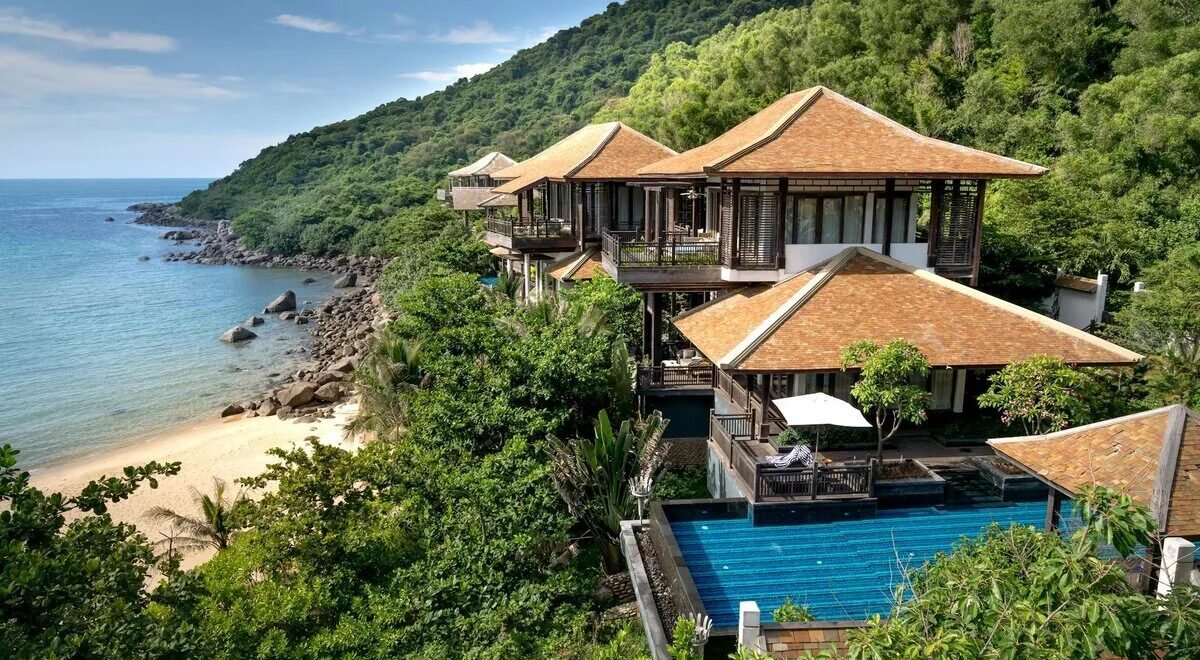
You acquire, you sign, and from there your unit enters the hotel pool: a shared income fund that Land of Nomads runs end to end. You get a quarterly distribution, reports with occupancy and performance, and a team on the ground that handles the day-to-day. You operate nothing.
There is a question that comes up in almost every conversation. Not the returns, those were already run. Not the leasehold, that was already understood. It is simpler and more human: fine, I sign, and then what? It makes complete sense, because you are putting six figures into an asset ten thousand kilometers away. You cannot drop by on a Saturday to check, or call the caretaker about a leak. Distance breeds uncertainty, and uncertainty is what weighs most.
The hotel pool: how income is shared
The hotel pool is the core of the model. Every unit in the development (eco-villas in San Fernando or eco-apartments in El Nido) forms a shared income fund run by Land of Nomads. Booking income is pooled and distributed among leaseholders by each one’s share.
Why a pool instead of income per single unit: because the pool cushions volatility. If your unit sat empty in February while your neighbor’s filled, a per-unit model would leave you at zero that month. With the pool, the development’s average occupancy sets your return, which smooths the peaks and troughs. The math runs like this: period income is aggregated, operating costs are deducted (marketing, platform commissions on the likes of Booking and Airbnb, cleaning, upkeep, insurance), the Land of Nomads management fee set in the contract comes off, and the net is distributed quarterly. You get a report with the full breakdown and the transfer goes to the account you nominate.
What reports you get, and in what detail
Transparency shows up as a report format, not a vague promise. The quarterly report covers gross pool income (broken down by channel), occupancy rate, average ADR (average daily rate), RevPAR (revenue per available room), itemized operating costs, the management fee and your net share, set against prior periods.
The annual report adds cumulative performance, a comparison with the three projected scenarios (conservative at 50%, expected at 65%, optimistic at 80%), the maintenance state of your unit and a projection for the next year. If there is a material incident on your unit or a regulatory change that touches the asset, you hear directly, off the calendar.
Who runs your unit every day
One advantage of the model is that you do not need to build your own team in the Philippines. It already exists. The operations team covers revenue management (rates tuned in real time to demand and season), housekeeping to a hotel standard (not a short-let standard, and the difference shows in the reviews), preventive and corrective maintenance, guest care during the stay and accounting.
The construction director oversees the build during the works phase and the structural upkeep after handover. The commercial team in Spain is your main point of contact if you are in Europe, and the legal team in the Philippines handles everything around the leasehold, contracts and local regulation, with more than nine years on the ground. Active leaseholders get a direct communication group where the team takes part, and each quarter there are online sessions with results, trends and live questions.
The scenarios that worry you
- If a guest damages your unit. The team inspects between stays, documents damage with photos and charges it to the guest’s deposit; if it runs over, the pool’s operating insurance steps in.
- If a typhoon hits. Units are built to resistant standards under the National Building Code of the Philippines, and the pool carries insurance covering natural-event damage.
- If occupancy drops. The three scenarios are built to weigh the reasonable worst case up front. Fall below the conservative one and your return dips, but the asset stays sound and Philippine tourism has a solid record of recovery.
- If you want to sell your leasehold. You can. The leasehold is transferable and Land of Nomads helps connect you with interested parties through its network of more than 400 leaseholders who have weighed the model.
You acquire, you sign, and from there you receive reports, returns and peace of mind. The rest is handled by the people who are there, on the ground, every day. To see the post-signing experience in more detail, San Fernando starts at $1,159.75 a month, and here is the detail on no-bank installment financing.