
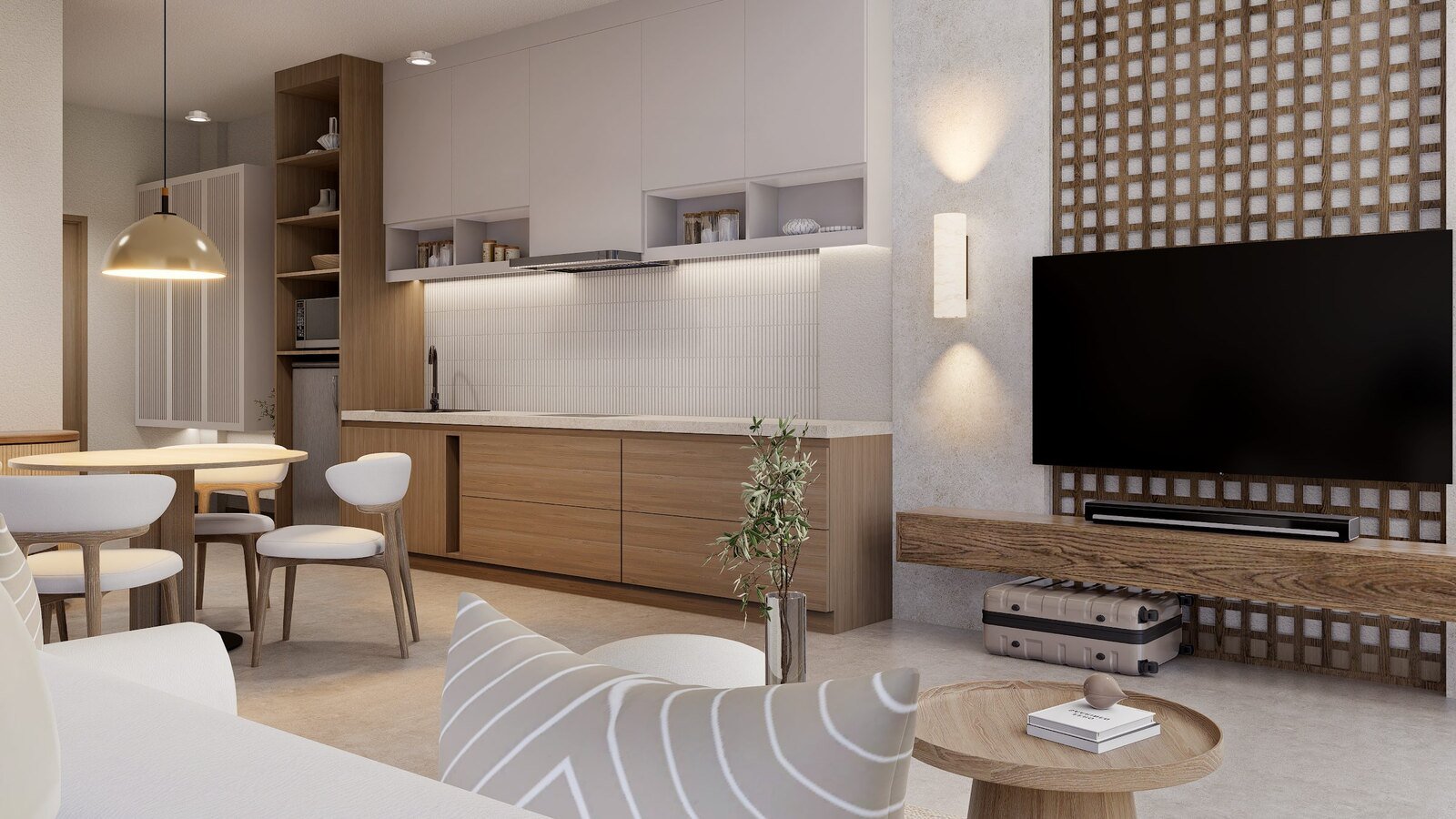
Short version: El Nido has two unit types, and the real difference is not the price, it is who sleeps inside. The Loft is 56 m² built around two people. The Duplex is 95,6 m² that carries a group or a whole family. Everything else follows: rate, estimated annual income, the shape of the booking calendar.
Two products, not two price tags
The usual mistake is reading the table top to bottom and coming away with one figure at 149.900 € and the other at 189.900 €.
That is the outlay. It is not the product.
The product is defined by the guest who fits inside, because that guest is the one deciding how many nights to stay, how far ahead to book, and what a night is worth to them. Change the guest and the whole operation changes, even when both sit on the same plot facing the same water.
So the useful comparison is never which one costs less. It is which guest each one serves, and whether that guest turns up in El Nido often enough to keep the calendar busy. Read the two lines that way and they stop looking like the same thing sold at two price points, which is how most listings quietly present them.
The Loft: two people and a fast decision
Fifty-six square metres. Rate from 220 € a night. Of the 231 eco-apartments in El Nido, 149 are Lofts, and that ratio is no accident: it answers who actually lands in Palawan.
Most international travellers reaching that far arrive as a couple or alone. They book with relatively little notice, stay a handful of nights, string El Nido together with another stop in the country, and want the space to work without a square metre going spare. A Loft handles that well.
In operating terms, that profile means rotation. Plenty of short stays, a calendar filling and emptying without pause, and a result that leans heavily on response speed: whoever answers a message the moment it lands closes the booking that somebody else loses by replying the next day.
The Loft carries an estimated annual income of 28.032 €, with an estimated payback period of around five years.
The Duplex: groups, families and longer stays
Ninety-five point six square metres, from 350 € a night, with 82 units built.
The guest here is a different animal. It is the family with children who need separate sleeping areas, the two couples travelling together, the group of friends splitting one place between several people and therefore reading the nightly rate through a different lens. None of those three fits in a Loft, and not as a matter of taste: they do not fit physically.
That guest behaves differently on the calendar. They book further ahead, because coordinating a whole group takes planning. They stay longer, because nobody assembles a trip like that for a couple of nights. And they rotate less, so the calendar fills with fewer entries and longer ones.
The Duplex carries an estimated annual income of 44.592 €, and its estimated payback period runs from four to five years.
Why the market accepts that gap in rate
This is the part that usually gets told badly.
The Duplex rate does not hold up because the place is bigger. It holds up because it answers a need the Loft cannot answer, and whoever pays by the night is not comparing square metres on a listing: they are comparing what the place solves. A family with children is not choosing between 56 and 95,6 m². They are choosing between sleeping under one roof or splitting into two separate bookings, with everything that costs in money and in friction.
That is where 220 € and 350 € come from as rate floors. Two markets living in the same destination without competing against each other.
And it is worth remembering what that word “from” means. It marks the floor, not the yearly average. High season lifts it, low season pulls it down, and the annual figure already carries that swing inside.
What changes on the calendar
Both start from the same base: an estimated annual occupancy of 50 % and expected growth of around 5 % a year on average, because a new development takes time to fill.
What differs is how each one gets to that 50 %.
The Loft reaches it through many short stays, so a stray midweek gap can be covered almost up to the last day. The Duplex reaches it through fewer, longer stays, so a cancellation leaves a wide hole that is hard to refill at short notice. Neither dynamic beats the other. They are two ways of running the same destination, and managed rental exists precisely so that neither depends on the holder watching a phone.
On top of that sits Palawan’s seasonality, which concentrates international demand between November and May. That pattern hits both unit types, though not identically: family groups move tied to school calendars, while couples have far more freedom to travel outside the expensive weeks.
Which one suits whom
The question is not which performs better on paper.
The useful question is what kind of calendar you want your unit to run, and what horizon you arrive with. Someone planning to use the apartment with their children every August is choosing the Duplex even when the numbers look easier on the Loft, because the unit has to serve two jobs at once: the guest who pays, and the weeks blocked out for personal use.
There is a wrinkle almost everybody misses here. August is not high season in El Nido, so blocking your summer weeks competes very little with the booking calendar, while blocking January is a different story altogether. Personal use does not cost the same depending on the month you place it in.
That is the point where the conversation stops being a table and becomes a specific case, with names, dates and a way of travelling behind it.
Frequently asked questions
Is the Duplex just a larger Loft? No. It is 56 against 95,6 m², but the decisive part is the layout: the Duplex is built to sleep more people in separate areas, and that opens a market the Loft cannot serve.
Why are there so many more Lofts than Duplexes? Because the ratio follows the destination’s demand. El Nido has 149 Lofts and 82 Duplexes built, and that split reflects how most travellers reach Palawan as couples.
Are the 220 € and 350 € rates the yearly average? No, they are the starting point. The annual average moves with the season, and the estimated annual income of each unit type already folds the strong months in with the thin ones.
Does the leasehold change by unit type? No. The leasehold runs 99 years on both, as does the managed rental arrangement and the right of use, uncapped by number of nights, with prior notice so dates can be blocked.
Choosing between Loft and Duplex has little to do with comparing two rows of a table and a lot to do with deciding who you want to host over the coming years. The Land of Nomads team goes through that fit case by case, without templates.